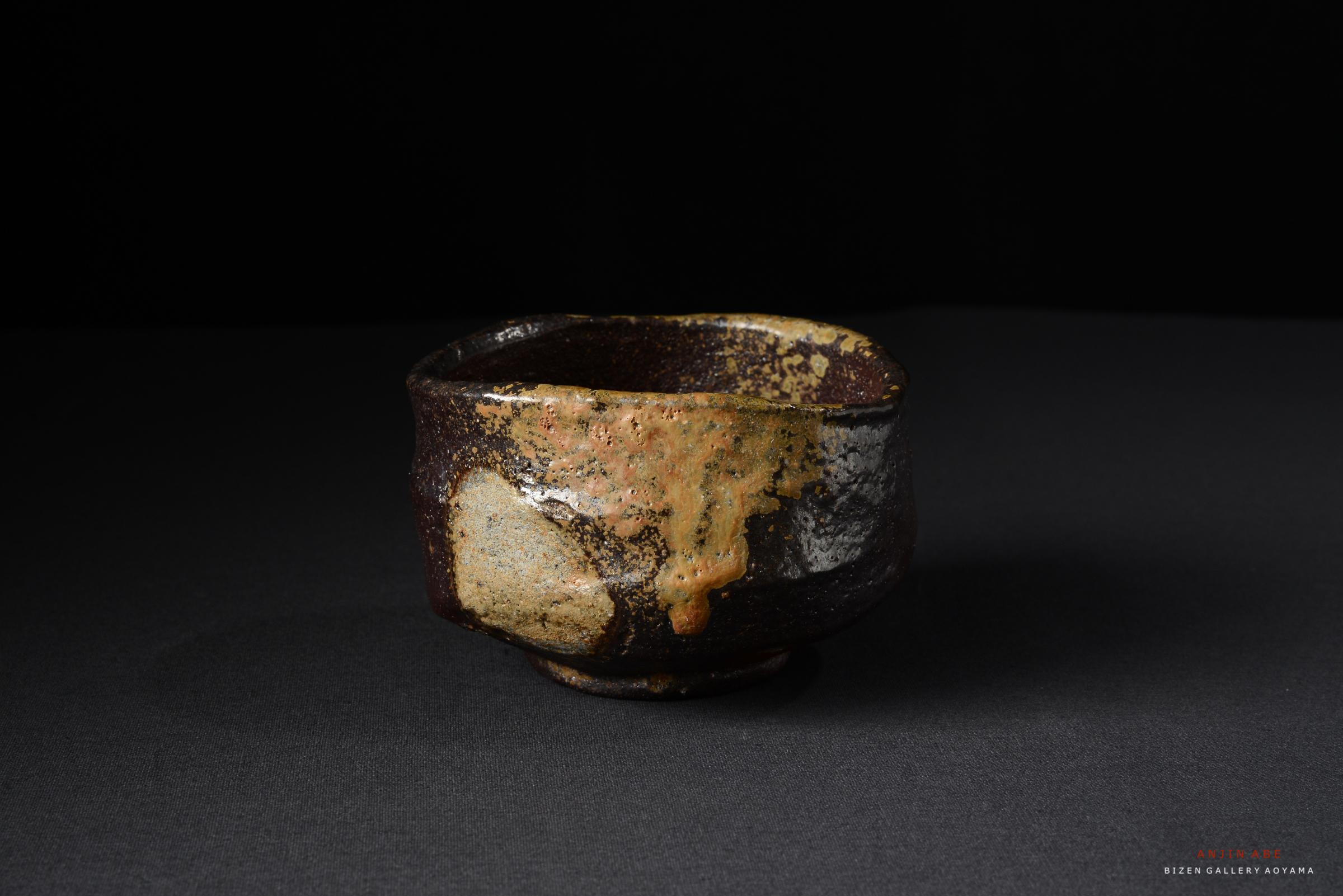
Bizen Chawan | Anjin ABE
備前茶碗 | 安倍安人
Size(cm)W12.6D12.5H8.4 Weight 455g, Shifuku & Double Wood Box
仕覆 二重箱
I believe the most remarkable thing about Mr. Abe is that he explores not only Bizen ware but also traces the origins of tea ceramics. His early fondness for antique ceramics and his realization of the disconnect he felt regarding contemporary ceramics have significantly shaped his current style as a potter; however, there is no doubt that his exploration of forms such as Raku ware—transcending the confines of Bizen ware to work as a creator of tea ceramics—has also profoundly influenced his creations.
There are many ceramic artists in Japan, but among those who dedicate themselves to the art of tea ceramics, there are surely very few like Mr. Abe. I feel that this piece is formed through a fusion of Raku, Oribe, Abe, and Bizen styles. I believe the profound sense of presence embodied in the tea bowl stems from that kind of underlying foundation. While there are many things that may appear similar but are fundamentally different, there is no doubt that Mr. Abe’s work is imbued with a profound level of insight.
He is one of those ceramic artists who truly puts into practice the principle of learning from the past to create something new.
I feel that many young ceramic artists today are so focused on pursuing new forms of expression that they are unfamiliar with the good things of the past. While I value the drive to pursue what is new—and certainly do not dismiss it—I believe that those who pursue innovation with an appreciation for the good things of the past are more likely to achieve great success.
(This discussion concerns domestically produced Japanese tea ceramics.)

