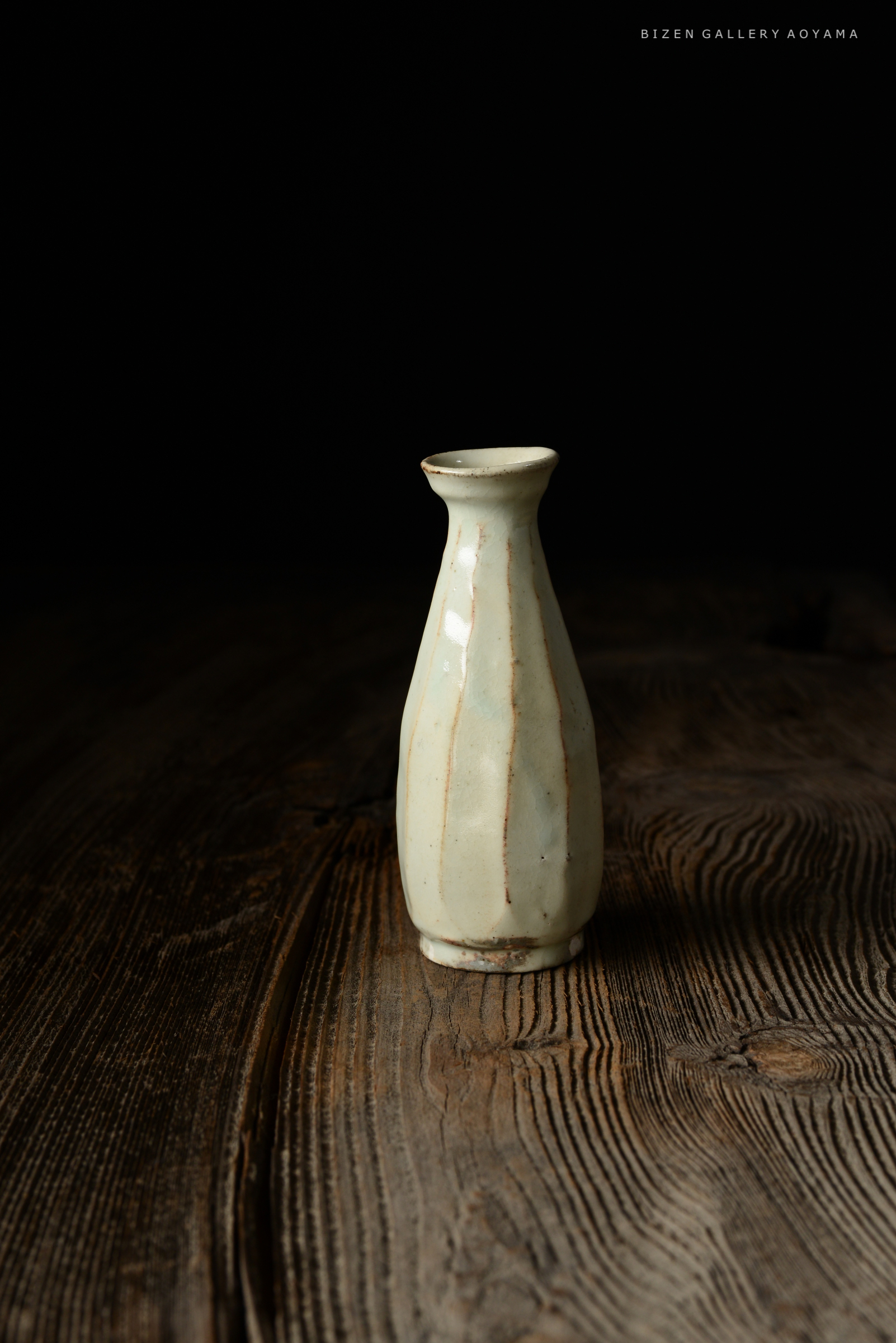
Kohiki Mentori Tokkuri | Hiomi TAKESUE
粉引面取徳利 | 武末日臣
Size(cm)W5.7H13.7
A world that cannot be explained in words
It is difficult to put into words why the sight of a “Amamori” exerts such a powerful appeal.
I leave it to others to employ complex vocabulary and craft literary expressions—that is not my forte—but why is it that Japanese people find a modest beauty and profound charm in things that are imperfect, or in the deterioration and changes brought about by the passage of time? While this aesthetic sensibility is unique to Japan, it is now widely recognized throughout the world.
The beauty that shines through the process of aging lies at the very heart of sabi—a traditional Japanese aesthetic sensibility. Unlike values that equate beauty solely with youth, perfection, or novelty, this perspective is remarkably rich and gentle; it affirms the profound character that emerges only with the passage of time and embraces the very process of change. This beauty of aging manifests in several ways: The beauty of “aging over time” (as taught by sabi) and the luster of an antique patina: Consider pillars or floors that have darkened and gained a rich sheen over the years—qualities absent in new timber. Scratches and shifts in color become unique adornments, telling the singular history of the object. Embracing imperfection: Much like kintsugi—the art of repairing cracked vessels with gold—this culture cherishes broken or worn elements not by hiding them, but by appreciating them as a new kind of charm or aesthetic character. The “beauty of aging” in human life: Refinement through stripping away the superfluous: This reflects a simplicity—akin to the spirit of wabi—where the excessive energy and ornamentation of youth are pared away, leaving only a person’s true essence and what matters most. Maturity and serenity: A personality softened and rounded by a wealth of experience, combined with a calm, unshakable presence, radiates an overwhelming sense of acceptance and depth that youth simply cannot replicate. The beauty of “withering” found in nature: Autumn foliage and fallen leaves: After the lush, vibrant peak of summer (youth) has passed, the autumn leaves—poised just before they wither—and the fallen leaves carpeting the ground possess a fleeting transience that gives them a brilliant, poignant radiance. Karesansui (dry landscape gardens): Just as stones and sand are used to represent the flow of water in a garden devoid of actual water, spiritual richness emerges more vividly once the physical body or material form has begun to fade.
As people age and their physical bodies and social roles evolve, certain abilities and traits may fall away, while others become sharply honed. This process of maturation—unique to the human experience—parallels the essence of sabi (a profound aesthetic quality that emerges with the passage of time). Key traits that become refined with age include the following: 1. “Intuition and Insight” to Discern the Essence and Eliminate the Superfluous: A lifetime of accumulated experience cultivates the ability to instantly distinguish what is truly important from what is trivial in complex situations. Enhanced Crystallized Intelligence: In psychology, “crystallized intelligence”—intelligence built upon years of accumulated experience and knowledge—is known to be maintained or even improved well into old age. 2. Emotional Control and a “Spirit of Acceptance”: Flexible Resilience: Having overcome numerous partings, setbacks, and realities that did not go as planned, one’s emotional volatility settles, fostering a tolerance that allows one to accept things as they are. Liberation from Attachment: The fixation on external validation—such as honor, wealth, or the opinions of others—fades, giving way to a priority on inner peace. 3. Self-Understanding and a “Unique Dignity”: Establishing an Authentic Self: By shedding social masks (persona) to the extent possible and acknowledging both one’s weaknesses and strengths, the contours of one’s true self become clearly defined. A Beautiful Presence: Even with few words, the atmosphere a person exudes and the life they have lived coalesce into a distinct “dignity” that imparts a sense of reassurance and gravitas to those around them.

